Does the Trinity Make Sense Logically?
A More Precise Perspective on the Triune God of the Bible

For a long time, I assumed the Logical Problem of the Trinity was essentially solved.
The argument is familiar:
There is one God.
The Father, Son, and Holy Spirit are each God.
The Father, Son, and Holy Spirit are not identical to one another.
At first glance, that looks like a contradiction. If each is God, and there is only one God, then shouldn’t they all be the same?
The standard response is equally familiar: God is one in essence and three in persons. Essence is not the same as personhood, so there is no contradiction.
And that’s true.

But it’s not yet precise enough…
Because the doctrine of the Trinity is making a stronger claim than that.
It’s not merely that God is one in one sense and three in another. It’s that the Father, Son, and Spirit share:
one being
one mind
one will
And yet remain genuinely distinct persons.
That raises a deeper question.
If knowledge, will, and essence are all shared, then what actually distinguishes the persons?
The Hidden Assumption
The Logical Problem of the Trinity depends on an assumption we rarely notice:
If two “things” share all the same knowledge, will, and nature, then they must be the same person—the same “I.”
That assumption feels obvious.
But it isn’t.
Knowing That vs. Knowing That I…
There is a difference between:
knowing that something is happening
and knowing that I am the one experiencing it.
You can know every fact about what someone is doing and still not know what it is like to be that person doing it.
Philosophers have long recognized this. In the thought experiment known as Mary's Room, Mary knows everything there is to know about color but has never seen it. When she finally sees red, it seems obvious that she learns something new—not a new fact about the world, but what it is like to experience it.
But we can push this a step further.

Imagine Mary is given not only all the facts about seeing red, but also a perfect copy of the experience itself. Even then, something would still be missing:
She would not thereby know that she was the one who originally had that experience.
Why?
If we cloned Adolf Hitler and gave this man a perfect copy of all his memories and personality traits, would punishing him be the same thing as punishing the Hitler of World War II?
Of course not. The original Adolph who actually did all those heinous acts, would not feel a thing.
Because first-person awareness, the “I” of experience, is not just another piece of information. It is non-transferable.
One Mind, Multiple “I’s”?
This leads to a surprising conclusion:
Sharing all the same information does not entail sharing the same first-person perspective.
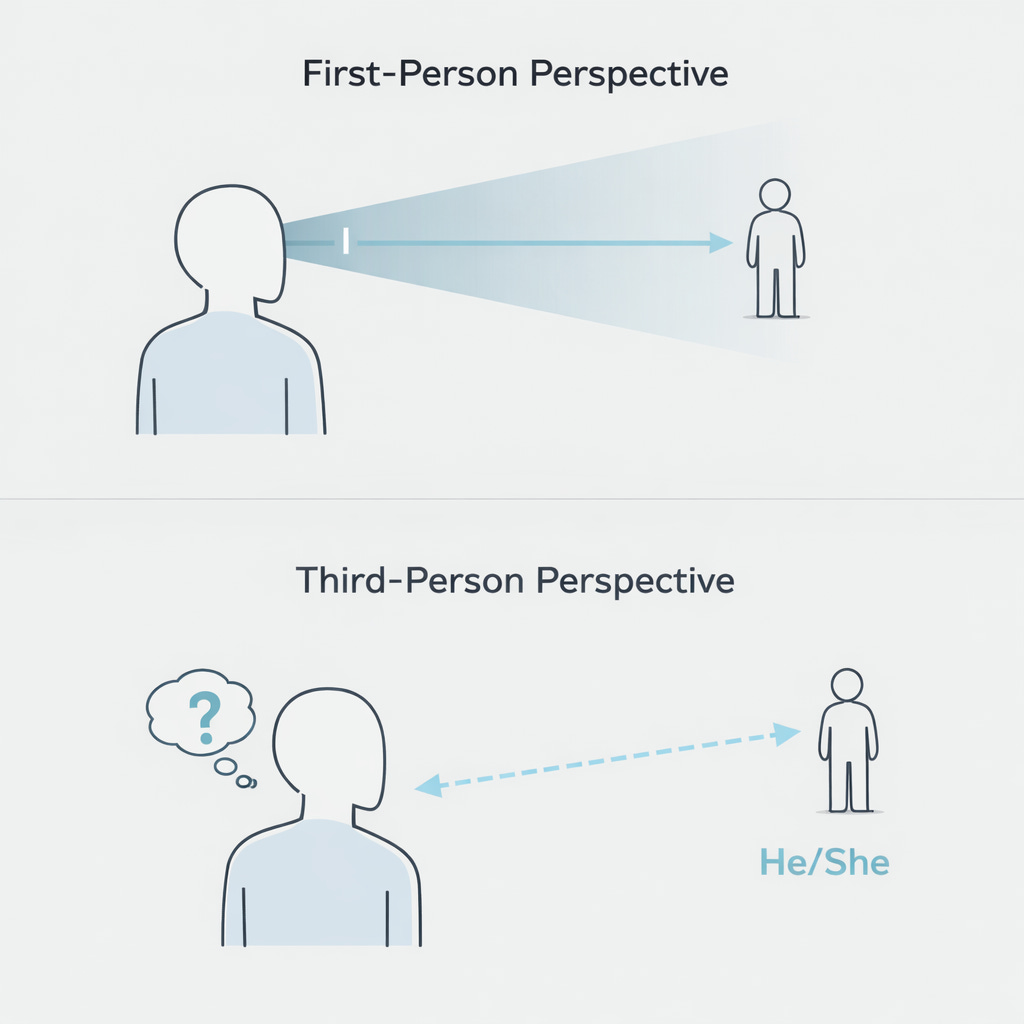
Two perspectives could, in principle, share:
the same knowledge
the same will
the same content
and still not be the same “I.”
There is no rule of logic that forbids this.
Application to the Trinity
The doctrine of the Trinity does not require us to posit three separate minds or three independent beings
Instead, it can be understood as saying:
There is one divine life: one knowing, one willing, one being, within which there are three irreducible, non-interchangeable “I’s.”
The Father is not the Son. The Son is not the Spirit. Each is a distinct “I.”
But they are not three gods, because they do not possess:
three separate wills
three separate minds
or three separate essences.
They share everything that makes God God.
What distinguishes them is not what they are, but who each is from within that one divine life.
A Glimpse from the Life of Jesus
This way of thinking also sheds light on something we see throughout the Gospels: Jesus praying—often alone.

If the Father and the Son share one divine life, why would Jesus pray at all?
Part of the answer is clear: He is setting an example for us. But that doesn’t seem to be the whole story.
What we see in those moments is not a breakdown in divine unity, but the expression of it through a genuinely human life.
In the incarnation, the eternal Son does not cease to share fully in the divine life. But He now lives that life through a human first-person perspective: one that is embodied, temporally situated, and expressed through attention, dependence, and action. When Jesus prays, He is not overcoming a lack of knowledge or reconnecting to something He has lost. He is addressing the Father as “You” from within His own irreducible “I.”
What might appear to us as distance is actually distinction.
Those quiet moments of prayer are not evidence that the Father and the Son are separate beings. They are a window into the fact that even within the unity of God, there is real, irreducible first-person relation.
Why the Logical Problem Fails
The Logical Problem of the Trinity only works if we assume:
One essence must entail one first-personal “I”.
But once we see that first-person perspective is not reducible to shared knowledge or will, that assumption loses its force.
And with it, the contradiction disappears.
This may not prove the Trinity is true.
But it does show something important:
The doctrine is not logically incoherent. The apparent contradiction depends on a hidden assumption about what it means to be a subject, an assumption we have good reason to reject.
Final Thought
We tend to think of unity as requiring a kind of simplicity that excludes internal distinction.
But the reality may be richer and more nuanced than that.
It seems possible for an entity to be fully one in what it is, and yet not exhausted by a single “I.”
And if that’s even conceptually coherent, then the Trinity is no longer a logical problem to be solved, but something we may seek to understand.
If you’re interested in learning more about the Trinity, check out my previous article below. But please consider leaving a LIKE before you navigate away.